Influencing the Treaty on Protection of Persons in the Event of Disasters (PPED)
⏳ Deadline: 2027
Toolkit Menu


START HERE
What This Toolkit Is
This advocacy toolkit brings together the collective analysis, evidence, and advocacy resources developed by DiDRRN and TGDRRCA to support coordinated engagement in the PPED negotiations. It is intended for organisations of persons with disabilities, humanitarian and disaster risk reduction practitioners, civil society organisations, academics, and other stakeholders working to ensure the future treaty is disability-inclusive.
How to Use This Toolkit
This advocacy pack is intended for civil society organisations, organisations of persons with disabilities, humanitarian actors, and anyone committed to ensuring that the rights of persons with disabilities are upheld in disaster contexts. It equips your team with clear talking points, evidence, and analysis that can be used internally for awareness-raising, or externally when engaging decision-makers.
You can use this pack to guide conversations with local politicians, government officials, institutional leaders, donors, and other stakeholders about what the PPED is, why disability inclusion matters, and what specific changes are needed in the treaty text. The resources here are intentionally practical, designed to be adapted to different audiences and contexts.
This is a live resource. It will be regularly updated to reflect the evolving negotiation process and emerging evidence. The information provided draws on ongoing analysis by our members and partners and will continue to grow as the PPED moves toward its 2027 deadline. For more information, contact us.
 Accessibility note: If you need this information in an alternative format — Easy Read, audio, large print, or another language — please contact us.
UNDERSTANDING PPED
What is PPED?
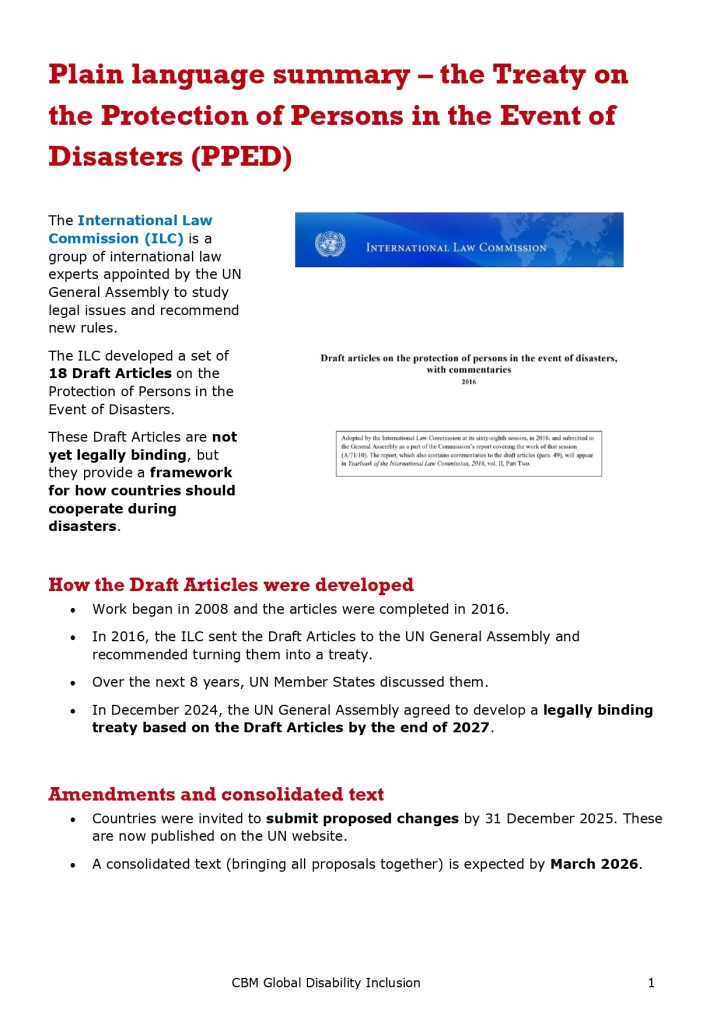
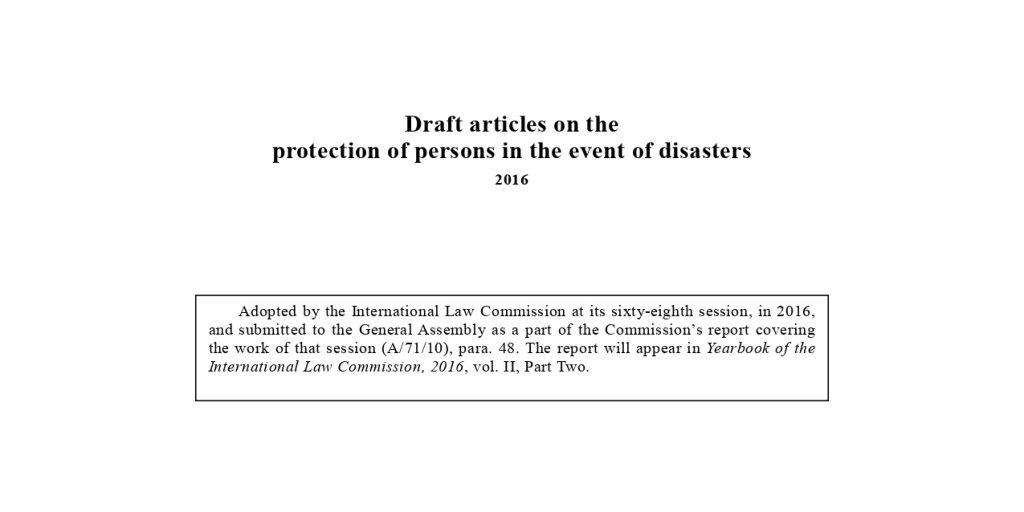
The Protection of Persons in the Event of Disasters (PPED) is an international treaty currently being negotiated at the United Nations. It is based on the Draft Articles developed by the International Law Commission (ILC) in 2016, and in 2024, the UN General Assembly formally agreed to turn these draft articles into a legally binding instrument, with a deadline of 2027.
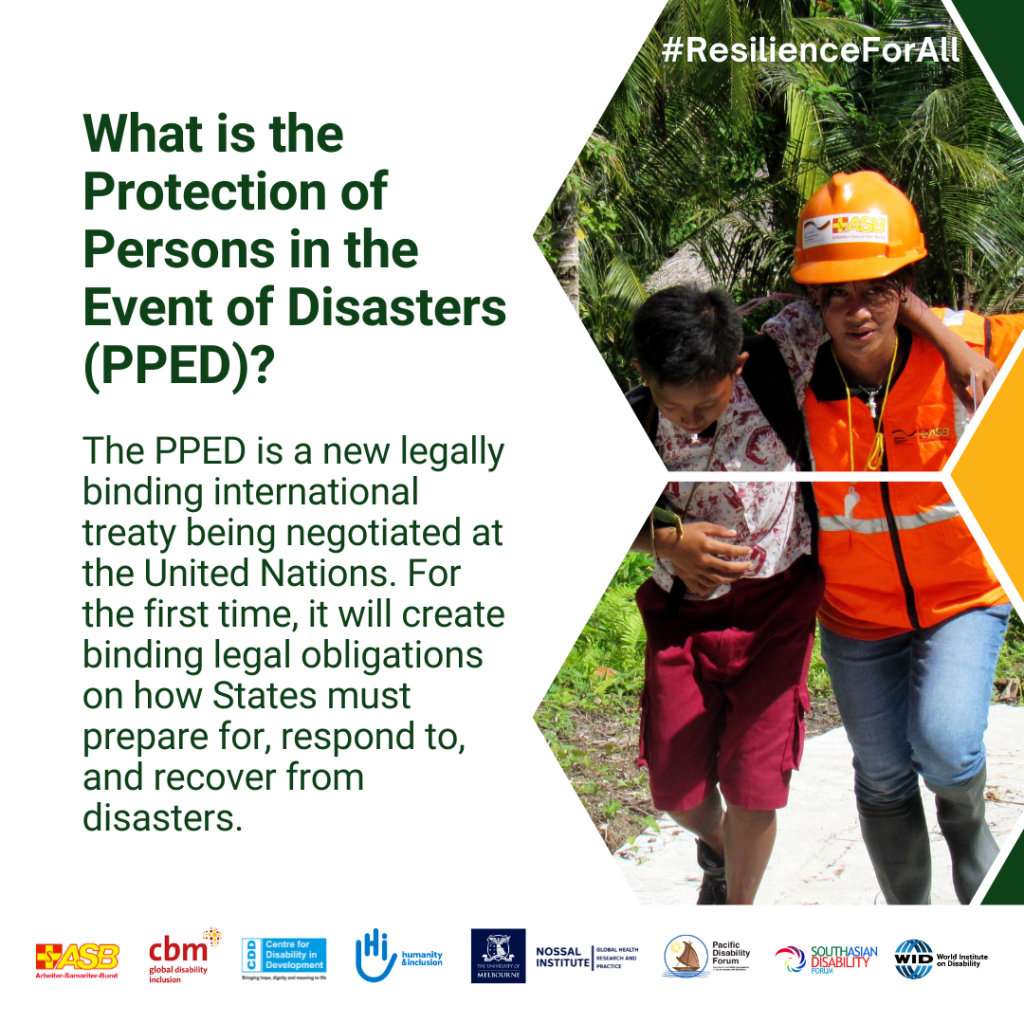
The PPED matters because, for the first time, it would create binding legal obligations on States about how they must prepare for, respond to, and recover from disasters. Right now, much of what States do in disaster situations is guided by non-binding frameworks and voluntary commitments. A binding treaty changes that — it creates accountability. For the disability community, this represents a critical window to ensure that the rights of persons with disabilities are not just mentioned, but legally required in how disasters are managed globally.
 The window is open — but closing. Treaty negotiations must conclude by 2027. Advocacy input from disability organisations, civil society, and National Societies is needed now to shape the final text.
Negotiation Timeline
2016 COMPLETED
ILC Adopts Draft Articles
The International Law Commission adopts the Draft Articles on the Protection of Persons in the Event of Disasters — the foundational text for the future treaty.
2024 COMPLETED
UN General Assembly Decides to Negotiate
The UN General Assembly adopts Resolution A/RES/79/128, formally deciding to negotiate a legally binding Convention based on the ILC Draft Articles, with a target of 2027.
2025–2026 ONGOING
Member State Submissions & Civil Society Advocacy
Member States submit written contributions to the negotiation process. Civil society organisations, OPDs, and humanitarian actors engage in advocacy to influence national positions.
AUG–SEP 2026 JUST CONCLUDED
Preparatory Committee — New York
The Preparatory Committee meets in New York to agree on the basis text for negotiations and establish modalities for stakeholder participation. Decisions on both have now been taken.
JAN–FEB 2027 VENUE TBC
Negotiating Conference — Three Weeks
A three-week negotiating conference is scheduled. The Philippines, originally set to host, will no longer serve as venue — though it remains a supportive State. The conference may take place at the same dates in a different location, or shift to later in 2027. Venue confirmation is pending.
JUL–AUG 2027 DETAILS TBC
Second Negotiation Window
A second negotiating window remains in the schedule. Location, format, and modalities have not yet been confirmed.
Beyond 2027
Adoption → Ratification → Entry into Force → Implementation
Upon conclusion of negotiations, the Convention is adopted and opened for ratification by Member States. Once a sufficient number of States ratify, the treaty enters into force and implementation begins — creating binding legal obligations on States for the first time in disaster protection.
⚡ Why this matters now
- Member States are currently negotiating the treaty text.
- Civil society still has an opportunity to influence governments before the Convention is adopted.
- Once adopted, changing treaty language becomes extremely difficult.
Key Provisions of the Treaty
The Draft Articles cover 18 articles across seven key areas. Click each to expand.
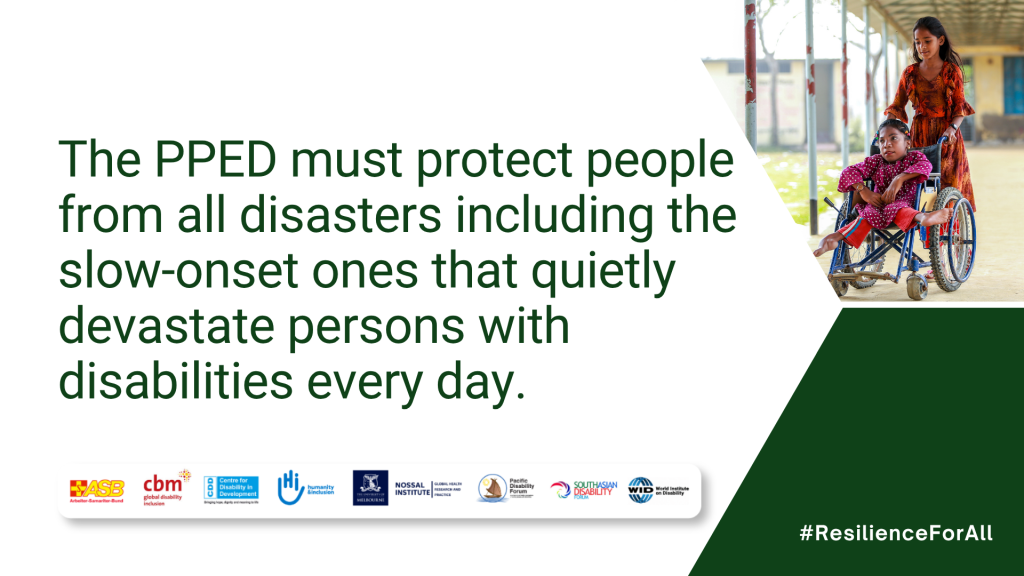
Scope and Purpose establish what the treaty covers. The current definition of “disaster” focuses on sudden-onset calamitous events, a gap that advocates are calling to expand to include slow-onset events such as drought and climate-related degradation, which disproportionately affect persons with disabilities.
Principles and Human Rights affirm that human dignity must be respected in disaster contexts, that existing human rights obligations continue to apply during disasters, and that humanitarian principles, including non-discrimination, must guide all response efforts. These articles are foundational for disability inclusion, but currently lack explicit reference to the CRPD.
Cooperation and Assistance obligate States to cooperate with each other, with the UN, and with humanitarian actors. This includes forms of assistance such as sharing relief personnel, equipment, and expertise. Article 7’s commentary already references CRPD Article 11, a positive entry point for advocates.
Disaster Risk Reduction addresses what States must do before disasters: risk assessment, early warning systems, and data collection. This is where the most critical gaps for disability inclusion lie, as the current text contains no reference to accessibility or the participation of persons with disabilities.
Responsibilities of the Affected State establish that the affected State has the primary duty to protect its population and must seek external assistance when its own capacity is exceeded. These articles define where the obligation to ensure inclusive response sits, and currently, they do not require that protection be accessible or disability-inclusive.
International Assistance governs how external assistance is offered, accepted, and delivered, including conditions on the quality of assistance and the protection of relief personnel. Article 14, which addresses quality of assistance, is a key target for advocates to embed accessibility and reasonable accommodation standards.
Relationship to Other International Law affirms that the treaty does not displace existing international obligations, meaning the CRPD, the Sendai Framework, and other human rights instruments remain in force alongside PPED.
WHY DISABILITY INCLUSION IN PPED
Why persons with disabilities are disproportionately affected
Persons with disabilities, who make up at least 16% of the global population, are among the most severely affected when disasters strike. This is not because disability itself puts someone at greater risk, but because disaster systems are routinely built without them in mind. When evacuation routes are inaccessible, when emergency alerts are issued only in formats people with disabilities cannot receive, when shelters cannot accommodate wheelchairs or assistive devices, and when relief workers have not been trained in inclusive response, the result is predictable and preventable harm.
The barriers are systemic and span the entire inevitable cycle of disasters. Before a disaster, persons with disabilities are frequently excluded from community preparedness planning. During a disaster, they face greater difficulty accessing early warnings, evacuation support, and emergency services. After a disaster, recovery systems often fail to account for the loss of assistive technologies, accessible housing, or community-based support, leaving persons with disabilities behind for longer and with fewer resources to rebuild.
Data & evidence
The evidence is clear and consistent. The 2023 UNDRR Global Survey found that 84% of persons with disabilities lack a personal disaster preparedness plan, and 56% cannot access disaster risk information in accessible formats. Only 8% report that their local disaster risk reduction plans address their needs at all. At the funding level, a review of OECD-DAC data from the same year found that only 17% of DRR-related Official Development Assistance (ODA) was reported as disability-related, meaning roughly 80% of global DRR funding does not reach or benefit persons with disabilities in any meaningful way. These figures point to a structural failure, not an oversight.
16%
of the global population are persons with disabilities
84%
lack a personal disaster preparedness plan
56%
cannot access disaster risk information in accessible formats
8%
report local DRR plans address their needs
80%
of global DRR funding does not benefit persons with disabilities
17%
of DRR-related ODA was disability-related
Sources: 2023 UNDRR Global Survey; OECD-DAC data review 2023.
The gap: what's missing in PPED now
Despite these realities, the current PPED Draft Articles fall significantly short of ensuring disability-inclusive disaster protection. While there are encouraging references, disability is listed among grounds for non-discrimination, the CRPD is cited in the commentaries to a handful of articles, and accessibility is briefly mentioned in relation to information, these references appear largely in the non-binding commentary sections rather than in the binding treaty text itself. Commentary does not create legal obligation.
At the level of substantive content, the gaps are significant. The treaty’s definition of “disaster” excludes slow-onset events such as drought and climate-related degradation that disproportionately harm persons with disabilities over time. Article 9 on disaster risk reduction — which covers early warning systems, risk assessment, and data collection — contains no language on accessibility or the participation of persons with disabilities. There is no requirement for disability-disaggregated data, no mandate for accessible communication in early warning systems, and no obligation for States to allocate budgets specifically for disability-inclusive disaster preparedness and response.
The PPED draft recognises disability in its commentary — but commentary is not law. Our advocacy goal is to move disability inclusion from the margins into the binding treaty text.
ADVOCACY GOALS FOR PPED
What we are calling for
Our advocacy goal is for the PPED to represent a rare opportunity to establish legally binding international obligations for disaster risk reduction and humanitarian response. Our collective goal is to ensure that disability inclusion is embedded in the operative text of the Convention (not only in its commentary) so that persons with disabilities are protected before, during, and after disasters on an equal basis with others. The recommendations in the accompanying Policy Brief provide a detailed legal analysis and proposed amendments to achieve this objective. Read the policy brief here.
TOOLS
Key Messages
We encourage you to draw on these messages across conversations, presentations, policy submissions, and advocacy materials, so our position is voiced consistently at every opportunity or wherever this issue is discussed.
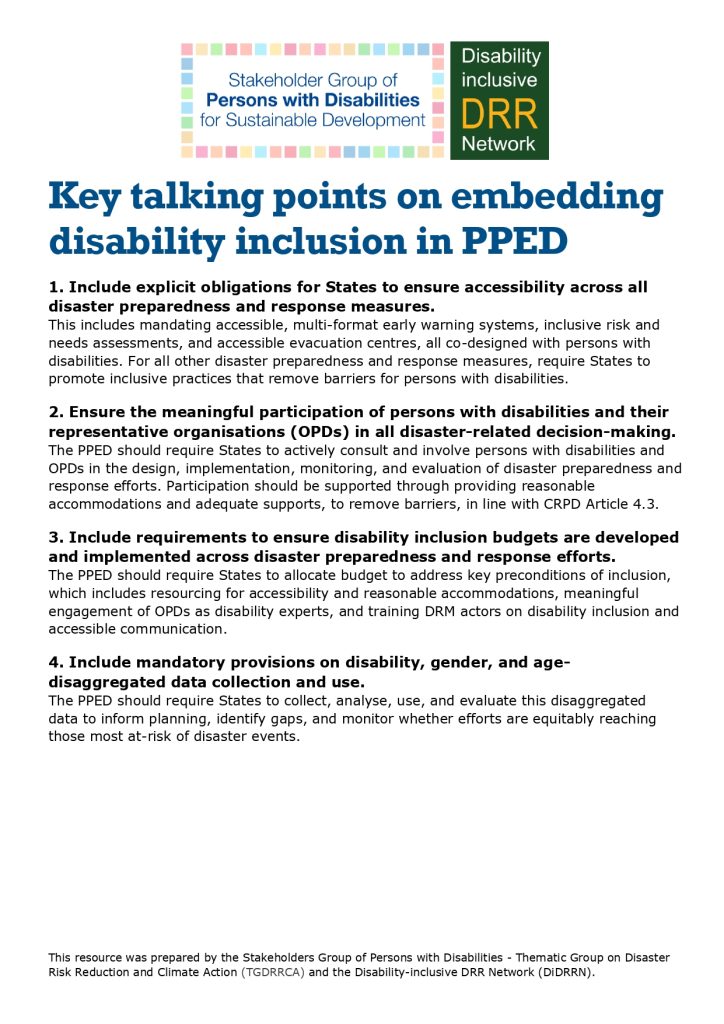
This includes mandating accessible, multi-format early warning systems, inclusive risk and needs assessments, and accessible evacuation centres, all co-designed with persons with disabilities, older persons and women. For all other disaster preparedness and response measures, require States to promote inclusive practices that remove barriers for persons with disabilities.
The PPED should require States to actively consult and involve persons with disabilities and OPDs, older persons, indigenous persons and women in the design, implementation, monitoring, and evaluation of disaster preparedness and response efforts, including in leadership and decision-making roles. Participation and leadership should be supported through providing reasonable accommodations and adequate supports, to remove barriers, in line with CRPD Article 4.3.
The PPED should require States to allocate budget to address key preconditions of inclusion, which includes resourcing for accessibility and reasonable accommodations, meaningful engagement of OPDs as disability experts, and training DRM actors on disability inclusion and accessible communication.
The PPED should require States to collect, analyse, use, and evaluate this disaggregated data to inform planning, identify gaps, and monitor whether efforts are equitably reaching those most at-risk of disaster events.
 Social media templates for sharing these messages are available in the resources section below.
TOOLS
Toolkit & resources
Access the documents, templates, and tools you need to advocate effectively.
Key documents
Easy Read Key Messages
Social media templates
Case studies
Browse documented examples of disability inclusion gaps and good practices in disaster contexts. Filter by country, region, or topic.
 Have a case study to share? Help us build the evidence base for disability-inclusive disaster response.
Having trouble?
Government engagement


Frequently Asked Questions
Is PPED replacing the Sendai Framework?
No. The PPED and the Sendai Framework serve different but complementary purposes. The Sendai Framework is a voluntary, non-binding global framework for disaster risk reduction. The PPED is a legally binding international treaty that would create enforceable obligations on States. The two instruments are designed to work alongside each other, not replace one another.
Why do we need PPED if we already have the Sendai Framework?
Because PPED is legally binding. Unlike the Sendai Framework, a ratified PPED treaty would create enforceable obligations on States — meaning governments can be held accountable for how they protect people during disasters. Voluntary commitments are important, but legal obligations carry greater weight and create stronger accountability mechanisms.
Does PPED only deal with response?
No. The PPED covers the full disaster cycle: prevention, preparedness, response, and recovery. This is why disability inclusion across all phases — not just the acute emergency response — is critical to advocate for in the treaty text.
Can NGOs and OPDs negotiate the treaty?
No. Only States can formally negotiate and adopt treaty text. However, civil society — including OPDs and NGOs — can meaningfully influence the process by engaging national governments, submitting written inputs, attending negotiation sessions as observers, and building coalitions that shape national positions before and during negotiations.
TAKE ACTION
Call to Action
There are concrete steps you can take right now to help shape a disability-inclusive PPED. Choose the actions that fit your organisation’s capacity and mandate.

Engage decision-makers
- Meet your Ministry of Foreign Affairs
- Meet your National DRR Agency
- Use the template letters

Strengthen the evidence base
- Submit case studies
- Share relevant research
- Document good practices

Join the movement
- Connect with DiDRRN
- Connect with TGDRRCA
- Join the IFRC Community of Practice
- Join the SEM Working Group on PPED
CREDITS
About This Toolkit
This advocacy toolkit has been developed collaboratively by the Disability-inclusive Disaster Risk Reduction Network (DiDRRN) and the Technical Group on Disability-inclusive Disaster Risk Reduction and Climate Action (TGDRRCA), drawing on contributions from organisations of persons with disabilities (OPDs), humanitarian organisations, disaster risk reduction practitioners, and disability rights advocates. It builds on the collective review of the PPED Draft Articles undertaken by members of DiDRRN and TGDRRCA and is intended as a practical resource to support coordinated advocacy throughout the PPED negotiation process.
Get in touch
We welcome your questions, feedback, suggestions, and collaboration requests.
— DiDRRN and TGDRRCA