Protection of Persons in the Event of Disasters
Start here
What This Toolkit Is
This advocacy pack is a curated collection of tools, evidence, and communication resources designed to help you and your organisation understand the Protection of Persons in the Event of Disasters (PPED) treaty and take action to ensure it is disability-inclusive. Whether you are new to the PPED or already engaged in the negotiation process, this pack gives you what you need to make the case for meaningful inclusion.
How to Use This Toolkit
This advocacy pack is intended for civil society organisations, organisations of persons with disabilities, humanitarian actors, and anyone committed to ensuring that the rights of persons with disabilities are upheld in disaster contexts. It equips your team with clear talking points, evidence, and analysis that can be used internally for awareness-raising, or externally when engaging decision-makers.
You can use this pack to guide conversations with local politicians, government officials, institutional leaders, donors, and other stakeholders about what the PPED is, why disability inclusion matters, and what specific changes are needed in the treaty text. The resources here are intentionally practical, designed to be adapted to different audiences and contexts.
This is a live resource. It will be regularly updated to reflect the evolving negotiation process and emerging evidence. The information provided draws on ongoing analysis by our members and partners and will continue to grow as the PPED moves toward its 2027 deadline. For more information, contact: [TBD].
Understanding PPED
What is PPED?
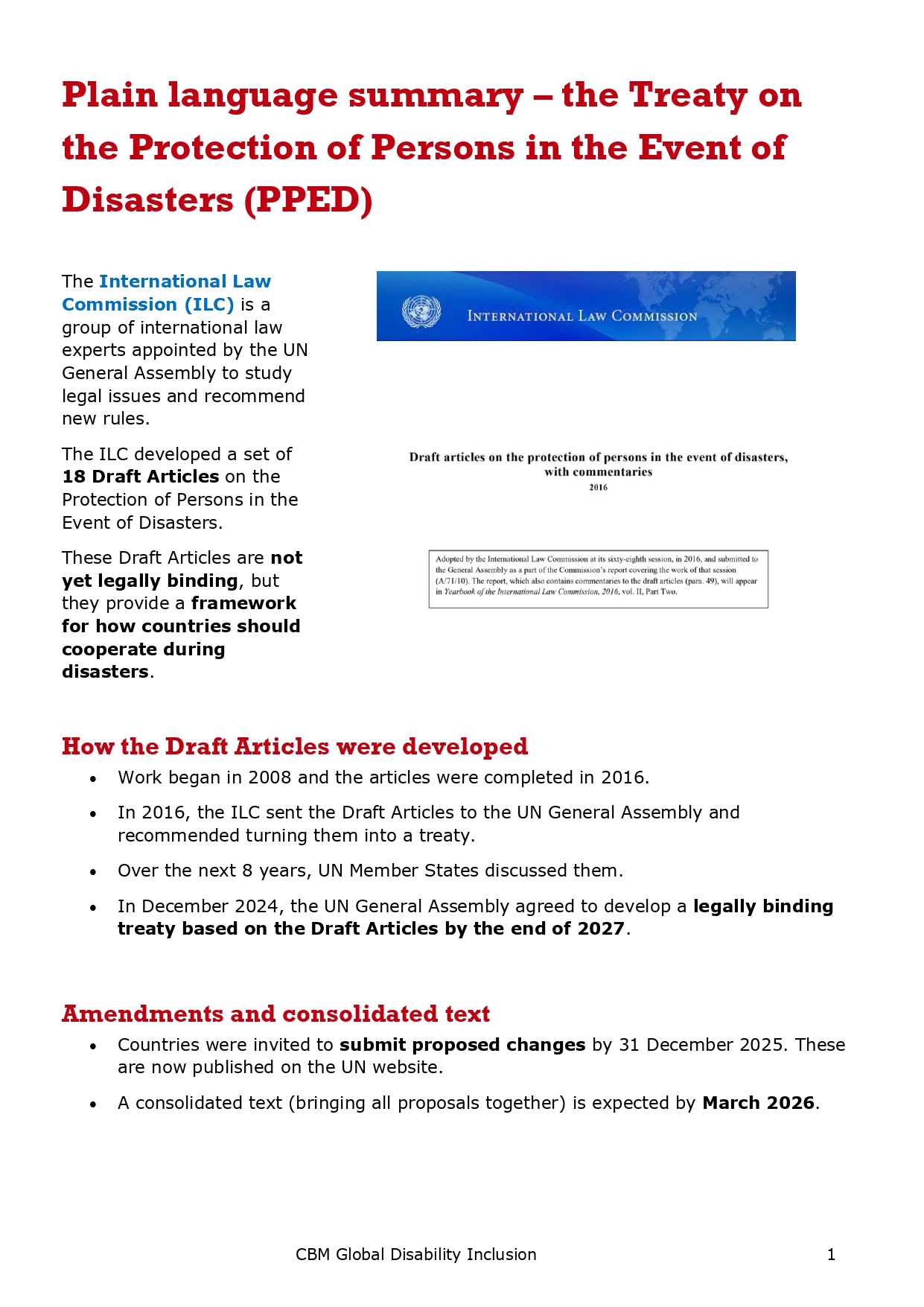
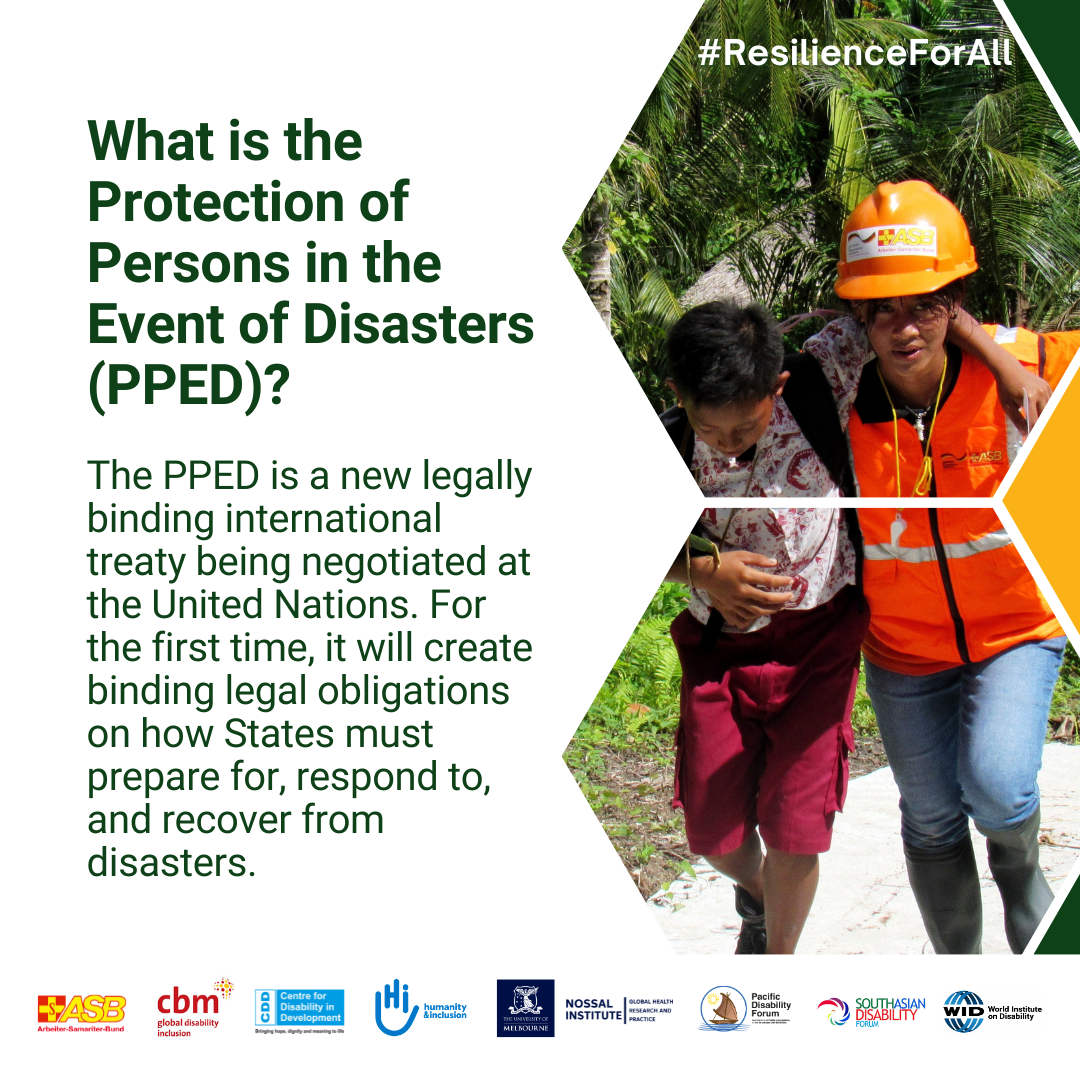
The Protection of Persons in the Event of Disasters (PPED) is an international treaty currently being negotiated at the United Nations. It is based on the Draft Articles developed by the International Law Commission (ILC) in 2016, and in 2024, the UN General Assembly formally agreed to turn these draft articles into a legally binding instrument, with a deadline of 2027.
The PPED matters because, for the first time, it would create binding legal obligations on States about how they must prepare for, respond to, and recover from disasters. Right now, much of what States do in disaster situations is guided by non-binding frameworks and voluntary commitments. A binding treaty changes that — it creates accountability. For the disability community, this represents a critical window to ensure that the rights of persons with disabilities are not just mentioned, but legally required in how disasters are managed globally.
Key Provisions of the Treaty
The Draft Articles cover 18 articles across seven key areas. Click each to expand.
Scope and Purpose establish what the treaty covers. The current definition of "disaster" focuses on sudden-onset calamitous events, a gap that advocates are calling to expand to include slow-onset events such as drought and climate-related degradation, which disproportionately affect persons with disabilities.
⚠ Key gap: slow-onset events excludedPrinciples and Human Rights affirm that human dignity must be respected in disaster contexts, that existing human rights obligations continue to apply during disasters, and that humanitarian principles, including non-discrimination, must guide all response efforts. These articles are foundational for disability inclusion, but currently lack explicit reference to the CRPD.
⚠ Key gap: CRPD not cited in binding textCooperation and Assistance obligate States to cooperate with each other, with the UN, and with humanitarian actors. This includes forms of assistance such as sharing relief personnel, equipment, and expertise. Article 7's commentary already references CRPD Article 11, a positive entry point for advocates.
✓ CRPD Art. 11 referenced in commentaryDisaster Risk Reduction addresses what States must do before disasters: risk assessment, early warning systems, and data collection. This is where the most critical gaps for disability inclusion lie, as the current text contains no reference to accessibility or the participation of persons with disabilities.
⚠ Key gap: no accessibility or inclusion requirementsResponsibilities of the Affected State establish that the affected State has the primary duty to protect its population and must seek external assistance when its own capacity is exceeded. These articles define where the obligation to ensure inclusive response sits, and currently, they do not require that protection be accessible or disability-inclusive.
⚠ Key gap: no disability-inclusive obligationInternational Assistance governs how external assistance is offered, accepted, and delivered, including conditions on the quality of assistance and the protection of relief personnel. Article 14, which addresses quality of assistance, is a key target for advocates to embed accessibility and reasonable accommodation standards.
⚠ Key gap: "quality" does not include accessibilityRelationship to Other International Law affirms that the treaty does not displace existing international obligations, meaning the CRPD, the Sendai Framework, and other human rights instruments remain in force alongside PPED.
Why disability inclusion in PPED
Why persons with disabilities are disproportionately affected
Persons with disabilities, who make up at least 16% of the global population, are among the most severely affected when disasters strike. This is not because disability itself makes someone vulnerable, but because disaster systems are routinely built without them in mind. When evacuation routes are inaccessible, when emergency alerts are issued only in formats that cannot be received by people with hearing or vision disability, when shelters cannot accommodate wheelchairs or assistive devices, and when relief workers have not been trained in inclusive response, the result is predictable and preventable harm.
The barriers are systemic and span the entire disaster cycle. Before a disaster, persons with disabilities are frequently excluded from community preparedness planning. During a disaster, they face greater difficulty accessing early warnings, evacuation support, and emergency services. After a disaster, recovery systems often fail to account for the loss of assistive technologies, accessible housing, or community-based support, leaving persons with disabilities behind for longer and with fewer resources to rebuild.
Data & evidence
The evidence is clear and consistent. The 2023 UNDRR Global Survey found that 84% of persons with disabilities lack a personal disaster preparedness plan, and 56% cannot access disaster risk information in accessible formats. Only 8% report that their local disaster risk reduction plans address their needs at all. At the funding level, a review of OECD-DAC data from the same year found that only 17% of DRR-related Official Development Assistance (ODA) was reported as disability-related, meaning roughly 80% of global DRR funding does not reach or benefit persons with disabilities in any meaningful way. These figures point to a structural failure, not an oversight.
Sources: 2023 UNDRR Global Survey; OECD-DAC data review 2023.
The gap: what's missing in PPED now
Despite these realities, the current PPED Draft Articles fall significantly short of ensuring disability-inclusive disaster protection. While there are encouraging references, disability is listed among grounds for non-discrimination, the CRPD is cited in the commentaries to a handful of articles, and accessibility is briefly mentioned in relation to information, these references appear largely in the non-binding commentary sections rather than in the binding treaty text itself. Commentary does not create legal obligation.
At the level of substantive content, the gaps are significant. The treaty's definition of "disaster" excludes slow-onset events such as drought and climate-related degradation that disproportionately harm persons with disabilities over time. Article 9 on disaster risk reduction — which covers early warning systems, risk assessment, and data collection — contains no language on accessibility or the participation of persons with disabilities. There is no requirement for disability-disaggregated data, no mandate for accessible communication in early warning systems, and no obligation for States to allocate budgets specifically for disability-inclusive disaster preparedness and response.
Beyond what is absent, some of what is present is also problematic. The use of the term "vulnerable persons" throughout the draft reflects an outdated, charity-based framing that positions disability as an inherent condition rather than recognising that people are made vulnerable by inaccessible and exclusionary systems. This framing is inconsistent with the CRPD and the Sendai Framework, both of which use rights-based language.
Perhaps most critically, the draft contains no safeguard against one of the most harmful practices that occurs during disasters: the institutionalisation or segregation of persons with disabilities in congregate settings. In practice, displaced persons with disabilities are frequently placed in institutions during emergencies, where risks of neglect and abuse are significantly higher. The PPED, as it stands, does not prohibit this, a gap that places it in direct conflict with CRPD Articles 14 and 19 on liberty and the right to live independently.
The PPED draft recognises disability in its commentary — but commentary is not law. Our advocacy goal is to move disability inclusion from the margins into the binding treaty text.
Advocacy goals for PPED
What we are calling for
Seven goals representing what disability-inclusive organisations are calling for in the final PPED treaty text. Click each to read more.
Broaden the Definition of "Disaster"
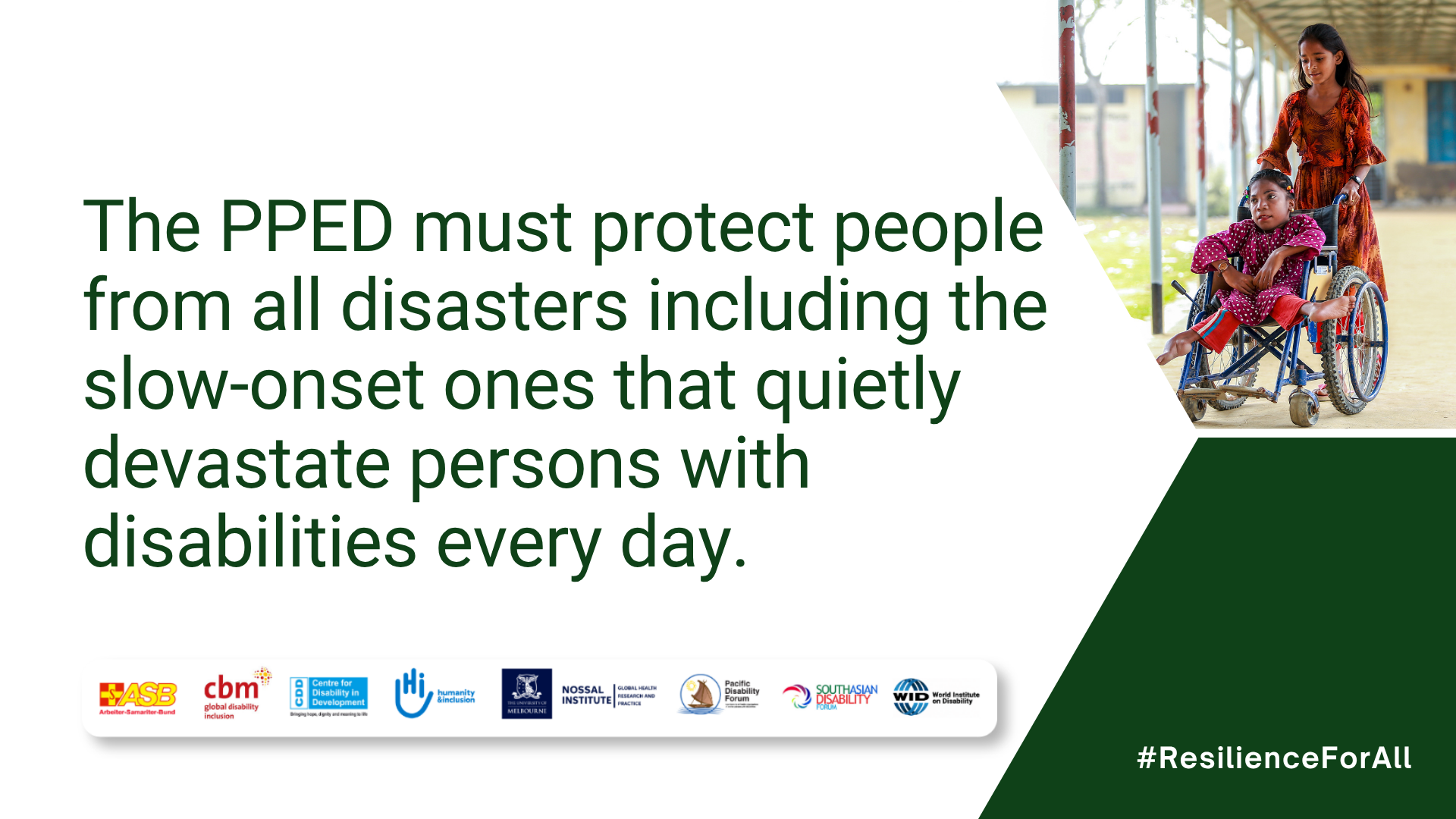
"The PPED must protect people from all disasters — including the slow-onset ones that quietly devastate persons with disabilities every day."
The current definition limits the treaty's scope to sudden-onset calamitous events, explicitly excluding slow-onset hazards such as drought, prolonged heat, sea level rise, and climate-related environmental degradation. This exclusion is not a technical detail — it determines when States' legal obligations are triggered and who falls within the treaty's protection. Persons with disabilities are among those most severely affected by slow-onset events, which progressively erode livelihoods, health, and access to support services. We call on States to adopt an all-hazards definition of "disaster" consistent with the Sendai Framework and CRPD Article 11.
Anchor the Treaty in a Rights-Based Framework
"Disability inclusion in disaster response is not a favour — it is a legal obligation under international human rights law."
The PPED must explicitly align with existing international human rights obligations, in particular the CRPD, within its binding text, not only in non-binding commentary. This means Article 4 on human dignity and Article 5 on human rights must directly reference CRPD Articles 3, 5, 9, 11, and 32, affirming that disability-inclusive protection is a legal obligation, not a policy preference. It also means replacing the term "vulnerable persons" throughout the draft with "persons in vulnerable situations" — language that correctly locates the problem in systemic barriers, not personal characteristics.
Guarantee Meaningful Participation of Persons with Disabilities
"Nothing about us without us: persons with disabilities must have a seat at the table in every phase of disaster planning and decision-making."
Persons with disabilities must be recognised explicitly, not subsumed under broad references to "vulnerable groups", as active participants in all phases of disaster management: preparedness, response, recovery, and treaty implementation and monitoring. This includes the meaningful involvement of Disabled Persons' Organisations (DPOs) in risk assessments, planning processes, and evaluation. Participation is not a consultation exercise. It is a substantive right under the CRPD, and the PPED must reflect that.
Require Accessibility Across the Entire Response Cycle
"A warning no one can hear, a shelter no one can enter, and aid no one can use is not protection — it is exclusion."
Accessibility must be a binding standard in the PPED, not an afterthought. This means: early warning systems must be available in multi-format and multi-channel communication including sign language, Easy Read, audio, Braille, pictograms, and local languages; evacuation routes and emergency shelters must be physically accessible; and Article 14's reference to the "quality" of assistance must be explicitly understood to include accessibility and reasonable accommodation. A disaster response that persons with disabilities cannot access is not adequate, regardless of how quickly it is delivered.
Make Disability-Disaggregated Data a Legal Requirement
"If disaster data does not count persons with disabilities, disaster systems will not protect them."
You cannot protect what you cannot see. The PPED must require States to collect, analyse, and use data disaggregated by disability alongside age, gender, and location to inform all stages of disaster planning and response. This is consistent with CRPD Article 31 and is essential for identifying who is being left out, where resources are needed, and whether responses are actually reaching persons with disabilities. Data collection must be done with DPOs, not merely about them.
Secure Dedicated Resources and Institutional Capacity
"Disability-inclusive disaster response requires dedicated funding — not goodwill, not footnotes, but budgets and accountability."
Disability inclusion requires investment. The PPED should require States to allocate specific budgets for disability-inclusive disaster risk reduction, including funding for accessible infrastructure, assistive technologies, communication systems, and support services. It should also require States to designate disability focal points within DRR institutions, and to invest in training for civil defence, emergency responders, and public officials. Critically, where States call for external assistance, that assistance must comply with CRPD Article 32: international cooperation must itself be inclusive and accessible.
Prohibit Institutionalisation During Disasters
"Disasters must never become a reason to lock persons with disabilities away — the PPED must explicitly prohibit institutionalisation."
The PPED must contain an explicit prohibition on the institutionalisation or segregation of persons with disabilities during disaster preparedness, response, and recovery. In practice, displacement frequently results in persons with disabilities being placed in congregate or institutional settings, where they face heightened risks of neglect, abuse, and loss of liberty. This is a direct violation of CRPD Articles 14 and 19, which affirm the right to liberty and independent living even in emergency situations. States must instead be required to direct resources toward accessible, community-based, and inclusive emergency shelter and relief services.
Tools
Key Messages
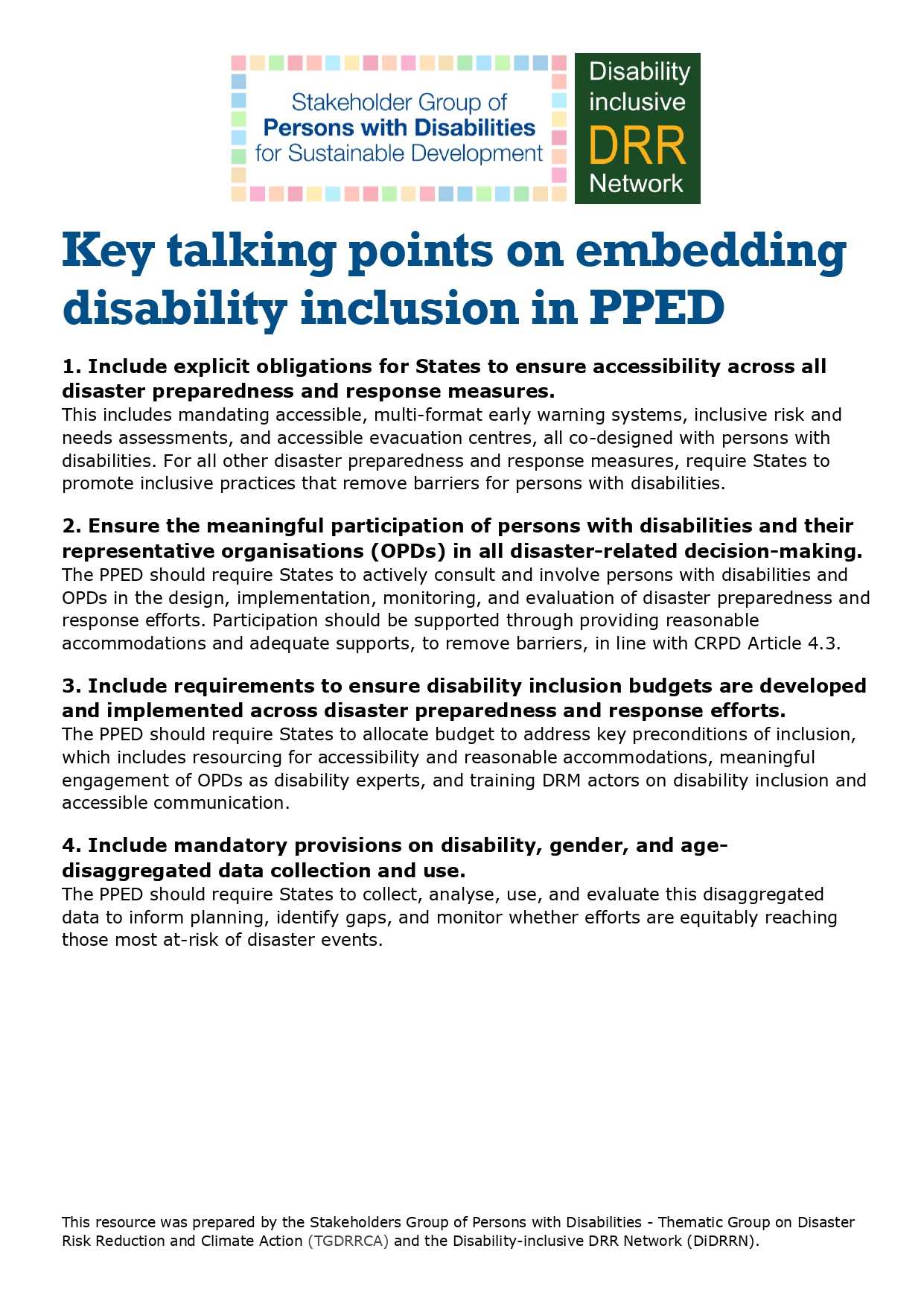
Use these messages in conversations, presentations, policy submissions, and advocacy materials. Each is designed to be clear, evidence-based, and adaptable to different audiences.
📱 Social media templates for sharing these messages are available in the resources section below.
Tools
Toolkit & resources
Access the documents, templates, and tools you need to advocate effectively.
Key documents
Social media templates
Case studies
Browse documented examples of disability inclusion gaps and good practices in disaster contexts. Filter by country, region, or topic.
Government engagement
Template letters
Ready-to-adapt letters for writing to your national government.
Coming soonTools
For organisations of persons with disabilities (OPDs)
OPDs are essential voices in the PPED negotiation process. This section is designed specifically to support OPDs in understanding their rights under the treaty and how to advocate effectively.
Your rights under PPED
- Right to protection in all disaster phases
- Right to accessible early warning systems
- Right to inclusive evacuation and shelter
- Right to non-discriminatory assistance
- Right to participate in planning and evaluation
- Right to accessible humanitarian assistance
- Right to live independently — even during disasters
How to advocate
- Use key messages in meetings with officials
- Submit written statements to UN Sixth Committee
- Engage your National Society in the IFRC Community of Practice
- Share case studies to build the evidence base
- Write to your government using template letters
- Use social media templates to raise awareness
- Connect with OPD networks (TGDRRCA, IDA)
The Disaster Law Treaty Community of Practice, spearheaded by the Italian Red Cross, connects National Societies and civil society organisations sharing advocacy strategies and lessons learned. Join here ↗
Questions or contributions?
We welcome your feedback, suggestions, or even collaboration requests.