Marking this year’s International Day for Disaster Risk Reduction, we revisit a conversation between disability rights advocate Supron Ridisno and UNDRR’s Marco Toscano-Rivalta on why inclusive disaster risk reduction must reach every household.
This year’s International Day for Disaster Risk Reduction (IDDRR), marked on 13 October, carries the theme “Resilience Starts at Home”. UNDRR describes the home as “both the primary site where disaster impacts are felt and the frontline of resilience-building”. Homes account for 43% of reported disaster losses.
But a home is only resilient when everyone in it is included. For many persons with disabilities, the risk comes from barriers: a warning that is not accessible, an evacuation route that does not work for them, or a household plan that was never made with them.
Supron Ridisno knows this from lived experience and years of work. An educator, author and disability rights advocate from Lampung, Indonesia, he is the first student with a vision disability to earn a doctorate from Universitas Islam Negeri (UIN) Raden Intan Lampung. He founded and chairs Yayasan Media Adaptive Lampung, whose community learning centre, PKBM Media Adaptive, offers equivalency education (Paket A, B and C) and trains persons with disabilities in screen-reader computing (JAWS), braille, Arabic braille and Qur’an reading. Through the Indonesian Blind Union (Pertuni) in Lampung, he has also helped develop inclusive DRR modules.
With support from ASB South and South-East Asia, Supron joined the Global Platform for Disaster Risk Reduction (GPDRR) 2025 in Geneva, where he spoke at a side session. On 6 June 2025, at the DiDRRN Innovation Booth, he also sat down with Marco Toscano-Rivalta, Chief of the UNDRR Regional Office for Asia and the Pacific, and asked him three questions. Marco’s answers read today like a guide to what “Resilience Starts at Home” means for persons with disabilities.
“We need your knowledge and capacity”
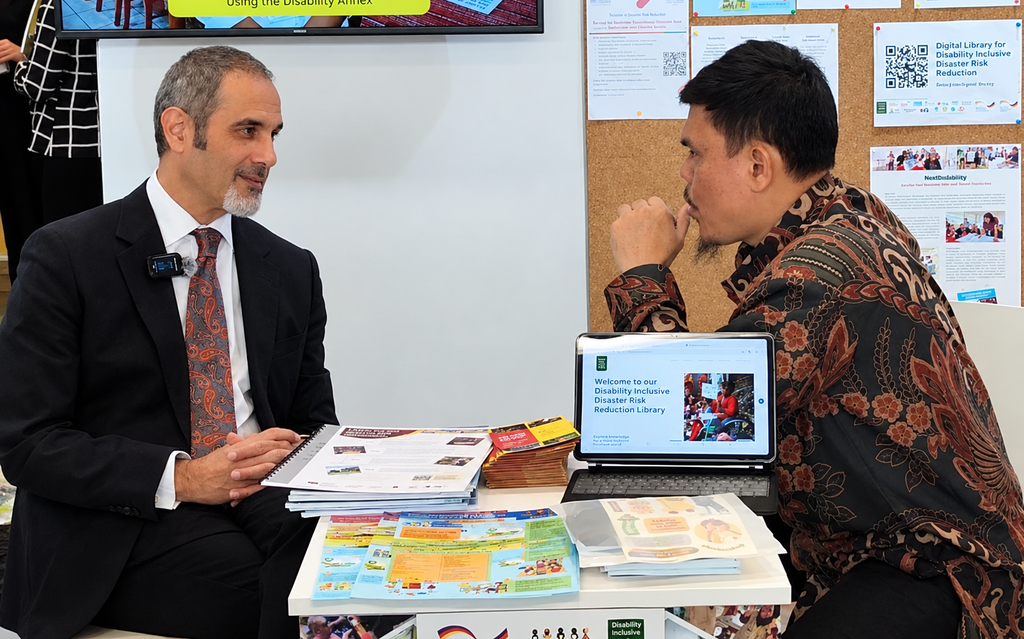
Supron’s first question went to the heart of it: why must persons with disabilities be part of disaster risk reduction (DRR)? Marco’s answer started with expertise, not need.
“The first reason is that we need your knowledge and your capacity,” he said. “When we look at the implementation of the Sendai Framework, disaster risk reduction is not as inclusive as it should be.”
The evidence backs him up. UNDRR first surveyed persons with disabilities on disasters in 2013. Organisations of persons with disabilities (OPDs) then led the push that made the Sendai Framework, adopted in 2015, much stronger on inclusion. Yet the 2023 follow-up survey, with responses from over 6,000 persons with disabilities in 132 countries, found limited progress. 86% reported no participation in community-level DRR decision-making and planning. At the same time, 57% said they would be willing to take part.
“Clearly there is much more that must be done,” Marco said, “and we need your continued leadership, working with us and working with governments, to really make things change at the local level.”
He pointed to early warning as proof of what that leadership achieves. “Travelling across the Asia-Pacific region, I have seen great examples where persons with disabilities and their organisations were involved in the design of early warning systems, and the results were immediately tangible.”
Marco also flagged a lower-profile process. The UN Committee on the Rights of Persons with Disabilities is drafting a General Comment on Article 11 of the Convention, which covers situations of risk. With OPDs at the table, he said, it can guide States Parties to give due attention to prevention, “which is really very much missing at the moment”.
OPDs: “already what is needed”
Asked what role OPDs can play in building resilient communities, Marco turned the question back to the people in the room. “I think what you have been doing is already what is needed,” he told Supron. He thanked him and “many thousands across the globe” working hard in this area.
What is missing, he said, is scale and influence. OPDs need to keep raising awareness and work much more closely with governments, so there is “full engagement in the definition of policies, of measures and investments”.
That is the same shift IDDRR 2026 calls for at the household level. UNDRR’s campaign page asks for the “meaningful participation of women, persons with disabilities and local communities” in housing and urban planning. It also urges building codes with “universal accessibility and inclusive design standards”. One of its key messages puts it simply: “Inclusion saves lives: resilience is strongest when everyone is part of planning and decision-making.”
Marco also named a funding commitment. Two months before GPDRR, the Global Disability Summit in Berlin closed with the Amman-Berlin Declaration. It sets a goal that at least 15% of development projects at country level focus on disability inclusion, known as “15% for the 15%”. “If I need to pick just one thing,” Marco said, “for me it is the 15% for the 15%. It is really, really an important one that hopefully can generate a big change.”
He was candid about the pace. With the Sendai Framework ending in 2030, “we need to focus on the now”. Inclusion came up in every GPDRR session he attended, he noted. “I’m happy, but not yet satisfied.”
A warning that reaches everyone at home
Supron’s last question asked for a message to everyone working to make DRR more inclusive. Marco’s answer was partnership: combining OPDs’ strong advocacy with UNDRR’s work so it has impact “at the country and the community level”, in policy design, project design and investment.
Then he picked one priority. “If I have to pick up one thing, it’s to work harder together on making early warning systems truly inclusive.” Getting that right, he argued, also makes the case for disability-disaggregated data and much more. “Let’s use early warning systems, and making sure that they are inclusive in reality, as an engine to actually advance the broader disaster risk reduction agenda.”
This is where the interview and this year’s theme meet. IDDRR 2026 stresses that warnings must reach every household member in accessible formats, and that people must know what protective action to take. In UNDRR’s words: “A warning that doesn’t reach the household, isn’t understood, or isn’t acted on is a warning that fails.”
A siren with no spoken instructions leaves a person with a vision disability guessing what to do. An announcement made only by loudspeaker never reaches a family member who is deaf or hard of hearing. Inclusive early warning is how “Resilience Starts at Home” becomes true for everyone in that home.
Marco closed by stressing that mobilising goodwill matters most “in times where international cooperation is being questioned”. “These are the times in which it is very important to come together, to stick together and to advance as a unified movement of goodwill for inclusive disaster risk reduction.”
Supron’s own work is a reminder that access to information is part of resilience at home. A person who can use a screen reader, a braille notice or a text alert is a person who can receive a warning and act on it.
This IDDRR, the message from Geneva holds: inclusive DRR starts with persons with disabilities and their organisations shaping the plans, warnings and investments that reach their homes. #ResilienceStartsAtHome #DRRDay